

Quinze Dias (Fifteen Days) is a Brazilian film that blends dramedy, romance and coming-of-age to tell a story that, despite its simple premise, finds plenty of room to talk about insecurities, feelings and, above all, the way we see ourselves and others. Directed by Daniel Lieff, written by Ray Tavares and Vitor Brandt and based …


Quinze Dias (Fifteen Days) is a Brazilian film that blends dramedy, romance and coming-of-age to tell a story that, despite its simple premise, finds plenty of room to talk about insecurities, feelings and, above all, the way we see ourselves and others.
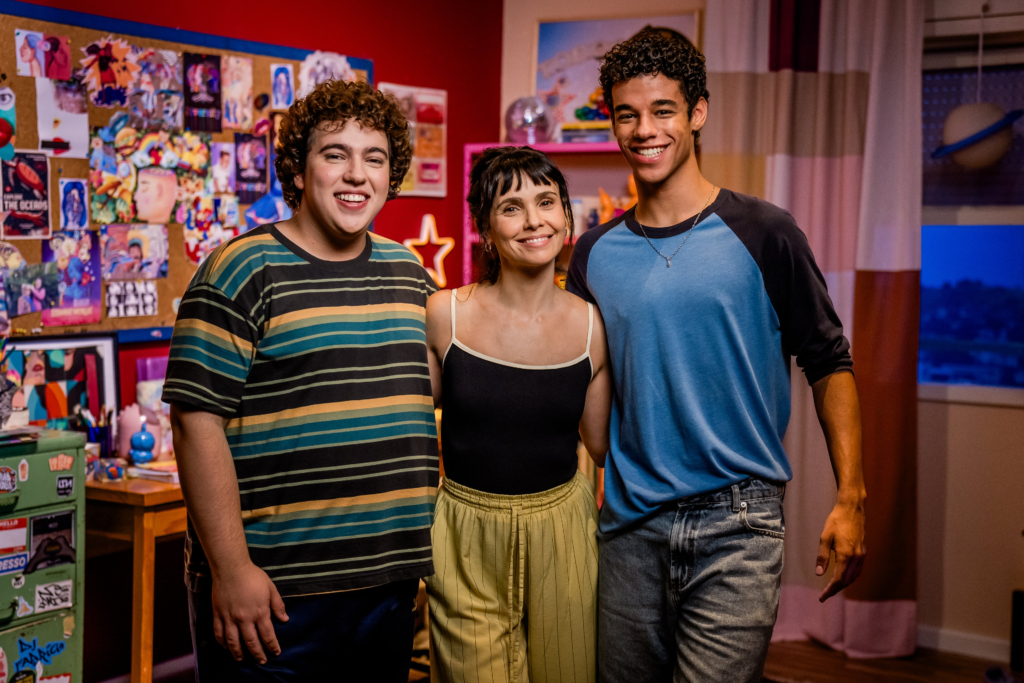
Directed by Daniel Lieff, written by Ray Tavares and Vitor Brandt and based on Vitor Martins’ novel of the same name, the film follows Felipe (Miguel Lallo) and Caio (Diego Lira) during their school vacation. Two completely different teenagers who end up growing closer and have to deal with feelings they didn’t quite know how to put into words until then.
Besides the leads, the cast includes Débora Falabella, Mariana Santos, Olívia Araújo, Mika Soeiro and Bel Moreira. Quinze Dias hit Brazilian theaters on June 18 but had a very low-key run, staying in theaters for only a few weeks with screenings in few cities and time slots. The film later arrived on Netflix, where it found a much bigger audience and inevitably started being compared to productions like Heartstopper, mainly for dealing with feelings, romantic discoveries and the challenges faced by LGBTQIA+ teenagers.
But before talking about why a story like this matters, it’s worth looking at what the film delivers as a work in itself.
When the “perfect boy” is far from perfect
One of the things that struck me most in Quinze Dias is how the script builds Felipe and Caio’s insecurities without turning either of them into a caricature.
Felipe is used to seeing himself as someone who doesn’t fit the standard. He’s a fat, shy teenager who has already learned to build defense mechanisms before anyone can attack him. But there’s a very interesting contradiction in this character: despite his insecurities about his body and the way he believes the world sees him, Felipe has an extremely understanding and functional family that gives him a safe space to exist.
Caio, on the other hand, seems to have everything Felipe thinks he’d like to be. He’s the conventionally attractive, seemingly confident boy who, in Felipe’s eyes, appears to have the perfect life. Except he doesn’t.
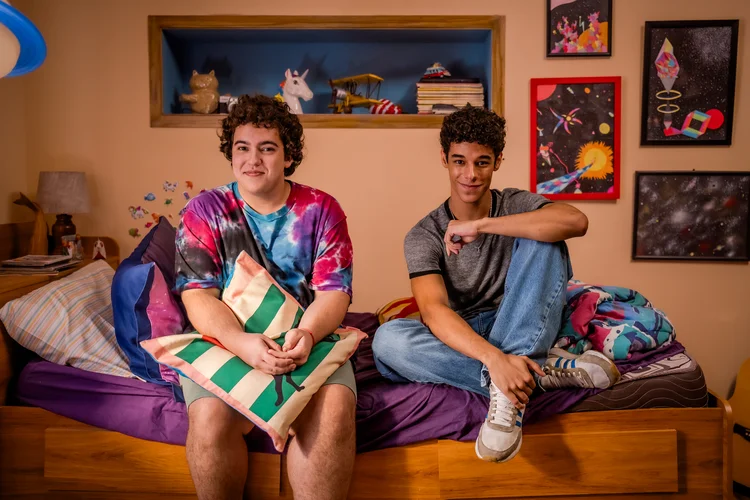
At home, Caio lives the exact opposite. His family is controlling, his choices are constantly questioned, and there’s enormous pressure for him to live up to the expectations placed on him.
That’s where the script finds one of its best ideas: what we see as perfect is almost never that perfect. Felipe looks at Caio and sees the boy he’d like to be. Caio, in turn, finds in Felipe some of the freedoms he’d like to have himself. It’s interesting to notice how the two spend much of the story wanting traits the other already has, without necessarily realizing it.
This reversal works really well because it takes the characters out of that very common “insecure boy needs to learn to love himself” logic and adds another layer: everyone has insecurities, even those who seem to have no reason at all to have them.
A story that knows how to be lighthearted
The script also gets the pacing right. There’s a flow that lets the viewer follow Felipe’s feelings almost at the same pace as he starts to understand them himself.
First comes self-protection, since Felipe is used to expecting attacks, rejection and judgment. Then, getting closer to Caio starts to dismantle some of those certainties. Confusion arises, along with the fear of misreading everything, and little by little the realization that maybe what he feared so much won’t happen.
I especially like how the film doesn’t turn this process into an overly heavy drama. Quinze Dias talks about bullying, insecurity, sexuality, family conflicts and relationships, but it doesn’t seem interested in making the viewer suffer the whole way through. There’s room for humor and, fortunately, it shows up quite often.
At many points, you can simply laugh at an absurd situation, at something the characters say or at events that come up almost at random. This helps the narrative because it gives the more delicate moments room to breathe.
The film understands that adolescence isn’t just suffering. Even when we’re going through something hard, we keep making jokes, talking nonsense, embarrassing ourselves and living through completely random situations. Quinze Dias manages to capture exactly that feeling.

The supporting characters get their space too
Another thing that works really well is how the supporting characters are built. None of them seems to exist just to serve a specific function in the story. They have their own personalities, conflicts and relationships with Felipe, making the world around the protagonist feel truly real.
Each relationship adds something to the character and, in some way, contributes to his growth. Even more importantly, the film doesn’t make Felipe’s growth something that happens only because of Caio.
Caio is obviously key to this journey, but Felipe is still Felipe before, during and after that romance. And that’s an important difference.


A summer that feels exactly like summer
Visually, Quinze Dias also knows exactly what it wants to deliver. The cinematography goes for warm tones, with that sunny aesthetic that instantly evokes summer. But it isn’t just a pretty choice. The cinematography speaks directly to the script and helps create the story’s atmosphere.
There’s a sense of warmth and freedom that perfectly matches what the characters are living through. And it gets even more interesting when the film goes inside Felipe’s head.
The editing plays with the character’s thoughts and fantasies, creating moments that step a little outside the traditional narrative. It works because Felipe is precisely a teenager who struggles to express himself to others but lives intensely inside his own head.
We follow not only what he does, but also what he imagines, wants and fears. These inserts help keep the narrative dynamic and stop the film from getting stuck in an overly linear structure. When reality meets Felipe’s imagination, we better understand the perspective of a shy, reserved teenager who often says much more to himself than he can express out loud.
It’s an aesthetic choice that works because it serves the story, and not just to make the film look “pretty.” That care also shows in the indoor and outdoor settings, the objects and the way each space relates to the characters.
The soundtrack adds to this identity by mixing international songs with a strong presence of Brazilian music. It’s especially nice to find artists with a close connection to the queer audience, such as Jão, Chico Chico and Johnny Hooker.

When a queer story can simply be a love story
Quinze Dias doesn’t invent the teen romance, and it’s far from the first production to tell a story about two boys falling in love. Nor is it the first Brazilian queer production, and I sincerely hope it won’t be the last.
But that’s exactly where the debate gets more interesting when we look at how stories like this are received.
There are countless films and series with heteronormative stories in which the girl seen as “ugly,” fat, awkward and insecure manages to win over the handsome, strong, athletic and popular guy. It’s a recurring romantic comedy fantasy, and nobody seems particularly concerned with questioning how possible that would be in real life.
So why does the bar change when we’re talking about a same-sex relationship?

Why is it so hard to accept the idea that a fat gay boy could be with another gay boy who fits society’s beauty standards? Why, when this dynamic shows up in a queer story, is there such a strong urge to compare it to reality, as if heteronormative fiction hadn’t spent decades doing exactly the opposite?
Nobody watches a straight romantic comedy expecting every aspect of that relationship to perfectly match reality. But when two boys like Felipe and Caio fall in love, part of the audience seems to feel the need to question whether that relationship could even exist.
Maybe this is one of the most interesting things about Quinze Dias. The film tells a familiar story without turning its characters into stereotypes. Felipe isn’t just “the fat boy who needs to learn to love himself.” Caio isn’t just “the handsome boy hiding his sexuality.” And their romance doesn’t exist simply to fulfill a fantasy.
They’re teenagers. They have fears, embarrassment, desires, fantasies, complicated families, friends, insecurities and completely silly moments. And that is real.
Not every queer love has to be a tragedy
Maybe that’s exactly what makes Quinze Dias so easy to like and, at the same time, so easy to criticize.
There’s something curious about the queer audience’s relationship with the stories produced over the years. We got used to seeing LGBTQIA+ characters associated with suffering: family rejection, bullying, violence, loneliness, conflict and, often, the impossibility of living love in a simple way.
So when a queer story comes along that just wants to be a teen love story, with humor, fantasy, embarrassment, butterflies and a happy ending, there seems to be some difficulty in seeing it for what it really is: a romantic comedy.
And why couldn’t it be?

LGBTQIA+ characters don’t have to carry the constant burden of representing every pain of the community. We can also simply watch two boys fall in love without demanding that this romance be an exact copy of reality.
Quinze Dias doesn’t need to be realistic in every way to have value. It’s enough to let a boy like Felipe be the lead of a love story. To let him be desired, loved and chosen without having to change who he is to deserve it.
He doesn’t need to lose weight to live a romance. He doesn’t need to stop being insecure. He doesn’t need to go through a tragedy for his story to matter.
And that alone says a lot.
Quinze Dias needs to exist, too
The film also holds an important place in Brazilian drama. A queer production with a light story, teenage leads and a romantic comedy structure, reaching a much bigger audience after its theatrical run and finding a home on a platform like Netflix, is something worth celebrating.
Quinze Dias doesn’t need to be perfect to be important. And maybe it doesn’t even need to be the best queer story ever told.
It just needs to exist.
Because the more stories like this get made, the less exceptional it will be to see LGBTQIA+ characters living what straight characters have lived for decades: first love, insecurities, fantasies, discoveries and, above all, the chance to simply be happy.
May Quinze Dias be not just one of the few, but one of the first of many. And from now on, may we have more and more Brazilian queer stories to watch, discuss, critique, love and, above all, normalize.