

The victory of a party close to the military surprises and frustrates Bangkok.


On Sunday, February 8, 2026, Thailand held its first general election since 2023. Voters were called to elect the 500 members of parliament who, in turn, will choose the country’s prime minister. Surprisingly, the Bhumjaithai Party, a conservative party, came out on top, defeating the People’s Party, which many saw as the favorite. In this article, we’ll try to understand what happened in this year’s election and what it means for Thailand’s future.

Thailand’s political situation since 2023
Like Brazil, Thailand has countless political parties that are always changing names (and ideologies). Party loyalty is low, with politicians switching parties as it suits them. There are, however, two parties further to the left of the political spectrum that are relatively stable and important for understanding Thai politics: the traditional Pheu Thai, and the newer and more popular People’s Party (formerly Gao Glai). These two parties received the most votes in the 2023 election, electing most of the MPs: 292 out of 500. However, they were prevented from forming a government, since the appointed Senate (chosen by the military) vetoed a government led by the People’s Party — considered too radical by conservatives. As a result, Pheu Thai (the more centrist left) was allowed to form a government on the condition that it share power with right-leaning parties, in a maneuver to block the more radical left.

In 2023, Pheu Thai formed a centrist coalition government, but one marked by chronic instability. The coalition was fragile, and Pheu Thai struggled to govern. Behind the scenes, conservative elites only tolerated Pheu Thai because the People’s Party seemed more threatening, which didn’t mean the government was ideal for the establishment. After ups and downs, prime minister Srettha Thavisin was removed by the Constitutional Court after only 358 days in office, on the grounds that he had violated ethics rules by appointing as minister a politician who had been accused of corruption years earlier.
Pheu Thai, however, stayed in power, naming Paetongtarn Shinawatra, daughter of the famous former prime minister Thaksin Shinawatra, as prime minister. But like her predecessor, Paetongtarn didn’t last long in office, being removed by the same Constitutional Court during the July–August 2025 political crisis, when she was found guilty of allegedly compromising national security. Her conviction stemmed from the scandal caused by the online leak of a phone call between her and Hun Sen, Cambodia’s prime minister. In the call, Paetongtarn says she wanted peace between Thailand and Cambodia and criticizes the exaggerated jingoism of the Thai army, which was using the border conflict with Cambodia to reassert militaristic nationalism.

After the Constitutional Court removed prime minister Paetongtarn in August, conservative politician Anutin Charnvirakul made a deal with the People’s Party, which held the largest bloc in Parliament. Since this left-wing party had no chance of forming a government because it was considered too radical, Anutin proposed a government led by his party, the conservative Bhumjaithai. In exchange for the People’s Party’s support, Anutin committed to delivering what the People’s Party wanted most: drafting a new Constitution to replace the current one — written by the military that staged the 2014 coup. The People’s Party accepted the offer and provided the votes needed for Anutin to be elected the new prime minister, which happened on September 5, 2025.

Once sworn in as prime minister, Anutin decided to call early elections, set for February 8 this year, and, in a major upset, not only won but elected more MPs than Pheu Thai and the People’s Party combined! Bhumjaithai won 193 seats, against 192 for the two left-wing parties (partial results as of February 10, 2026). But what happened in such a short time (between September 2025 and February 2026) for a small party like Bhumjaithai to grow so much? And why did the progressive parties decline so sharply? Did the People’s Party really get fewer votes than Bhumjaithai? Was there fraud? What will Thailand’s future be? I’ll try to answer each question individually.
Why did Bhumjaithai grow so much?
Answering this question requires understanding a bit about the Thai electoral system, as well as the difference between Bangkok and other larger cities on one hand, and the countryside on the other.
Unlike Brazil, which is a highly urbanized country, Thailand is a rural country, with almost half the population living in the countryside. There are few large cities, and only Bangkok could be considered large by Brazilian standards. Other cities, like Chiang Mai or Pattaya, would be classified as medium-sized or even small cities in Brazil.
Another striking difference between Brazil and Thailand is that our country has a presidential system: whoever gets the most votes wins, period. In Thailand, which has a parliamentary system, whoever gets the most votes doesn’t always win. Voters don’t vote for the executive (president or prime minister), but for the legislature (parliament), and MPs elect the country’s new leader.
The Thai parliamentary system has two types of vote: 1) the constituency vote, which is the vote for a local MP — similar to our federal deputies; 2) the party-list vote, which is the vote for the voter’s preferred party. In other words, Thai voters choose both a local MP and a party they prefer. The two votes don’t have to match, however. In the first vote, a person can choose a local MP from one party but vote for another party in the second.
However, winning the local MP race is far more important than winning the party vote. While the first vote fills 400 seats in Parliament, the second fills only 100.
Because of the deeply rural nature of Thailand’s countryside, the constituency vote tends to be based much more on personal relationships than on ideologies or political preferences. During its months in power, Bhumjaithai did its homework: thanks to its economic power, it recruited several politicians from other local parties into its ranks, filling its lists with local candidates already known to voters. These rural voters may even sympathize with progressive parties, but they prefer to vote for MPs they know and believe can solve local problems. As a result, Bhumjaithai fielded far more local candidates in this election than any other party, and gained more visibility by having better-known candidates with more established images among rural voters. This gave it the advantage that made its victory in the constituency races in the countryside possible. In cities like Bangkok and Chiang Mai, on the other hand, the People’s Party won, but it wasn’t enough to offset the countryside.
In short: Bhumjaithai grew because it attracted — through campaign money and deals — local politicians known to rural voters, consolidating a rural dominance that outweighed the People’s Party’s hegemony in the cities and in the party-list vote.

Source: The Nation
Did the People’s Party really get fewer votes than Bhumjaithai?
The decline in votes for Thailand’s two progressive parties is undeniable. The People’s Party elected 118 MPs in 2026, far fewer than the 151 in 2023. In absolute numbers, the party got 7.8 million constituency votes and 9.7 million party-list votes, totaling about 17.5 million votes. In 2023, the numbers had been better: 9.6 million constituency votes and 14.4 million party-list votes, totaling 24 million votes. In other words, the party fell from 24 to 17.5 million votes. As for Pheu Thai, the situation is even worse. The party fell from 20 million total votes in 2023 to just under 11 million in 2026!
We can reflect on the reasons for this decline. I’ll highlight a few:
1) Pheu Thai’s mistake in agreeing to form a government in 2023 alongside right-wing parties, which weakened its standing among many voters, who came to see it as a traitor to the progressive cause;
2) the People’s Party’s mistake in trusting Bhumjaithai, giving Anutin the chance to become prime minister, which allowed him to build dominance in the countryside and cancel out the preference for the left in the cities and in the party-list vote;
3) the growing estrangement between Bangkok and the countryside, which seem increasingly distant in their worldviews — while Bangkok is more ideological and anti-military, the countryside votes in a less ideological and more pragmatic way, and is less opposed to militarism;
4) the disillusionment of left-wing voters, who were disappointed that the People’s Party won in 2023 but was prevented from governing — turnout fell from 75% in 2023 to 65% in 2026;
5) the nationalist sentiment sparked by the war with neighboring Cambodia increased the military’s popularity, especially in the countryside and border provinces — which favored Bhumjaithai, with its bellicose pro-military rhetoric, as opposed to the progressives’ defense of human rights.
6) the split between Pheu Thai and the People’s Party, whose leaders (and voters) hate each other, each accusing the other of playing into the right’s hands, which weakened the progressive camp.
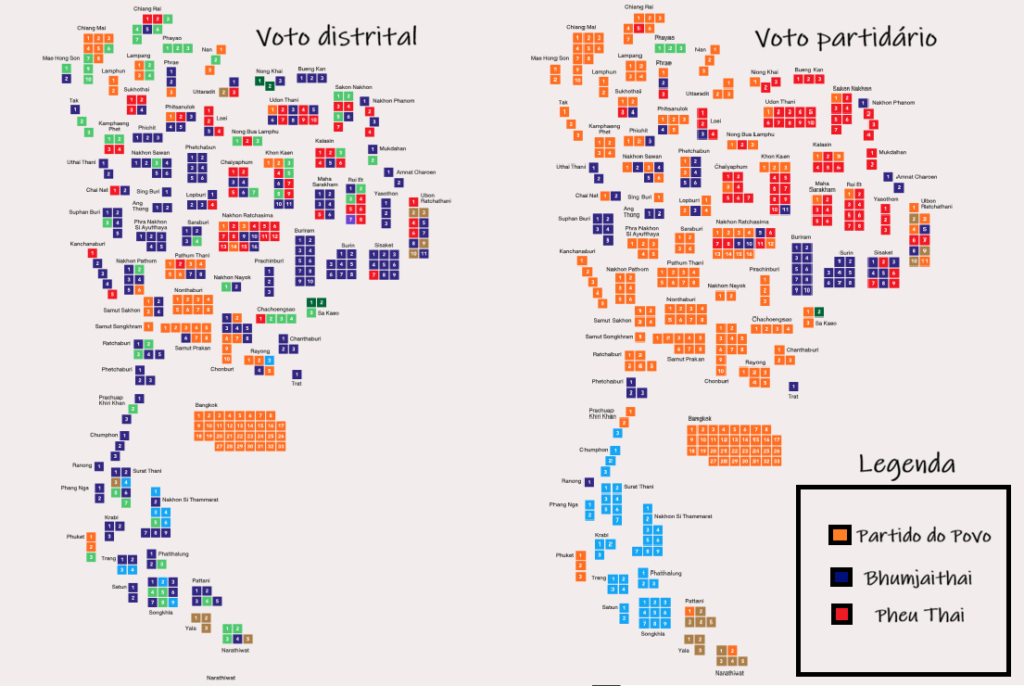
The most curious thing, however, is that Bhumjaithai was NOT the most-voted party in this election. The conservative party got about 16 million total votes, that is, a million and a half fewer votes than the People’s Party. But how is it possible to get fewer votes and still win? As I explained, in the parliamentary system, the one who gets the most votes doesn’t always win. The People’s Party won the party-list vote by a wide margin but lost the constituency vote, meaning its candidates won in fewer districts. Since the MP vote is more important because it offers more seats in parliament, the People’s Party’s lead in the party-list vote doesn’t carry enough weight to offset its defeat in the constituency vote (see the image below).
Source: https://www.thaipbs.or.th/election69/result/en?tab=summary
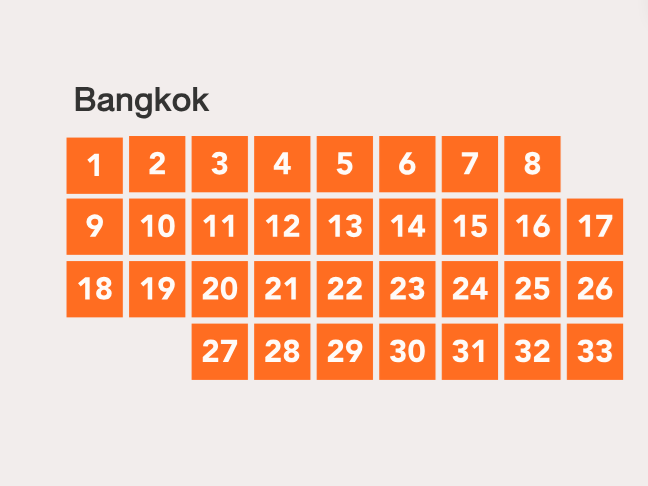
It’s important to stress that, unlike in the 2023 election, when the People’s Party was blocked by institutional maneuvering, the rule that the constituency vote counts more than the party-list vote is common in parliamentary systems and is within the rules of the game. The People’s Party’s dominance in the party vote weakened but didn’t disappear. However, dominance in the districts went to Bhumjaithai. Bangkok and its metropolitan area, in turn, backed the People’s Party, giving it both the constituency and party-list win in every electoral district (see below).
Was there fraud?
The Thai voting system is outdated and entirely paper-based. As I write this, only 94% of the votes have been counted, and the final result should take weeks, since counting is manual. Fraud scandals have always been common in election news, and this time was no different. There are suspicions of fraud reported by the press and shared on social media, such as the episode in district 7 of Pathum Thani, where favoritism toward Bhumjaithai was allegedly proven (the election commission denies it). As I write, there are suspicions of fraud in district 1 of Chonburi province, which have sparked public protests against the officials responsible for counting the votes (see the video below). However, the irregularities seem to have been isolated, and there’s no evidence that this election was more fraudulent than previous ones. It’s likely that Bhumjaithai’s strong performance in the constituency vote really reflected the will of rural voters. In any case, we’ll see in the coming days whether the fraud allegations grow or fade.
A young Thai man accuses Chonburi election commission officials of ignoring fraud complaints. The video went viral on Tuesday, February 10.
What’s next for Thailand?
The future seems uncertain. A new constitution will be drafted under Bhumjaithai’s leadership. It will likely be less authoritarian than the 2014 military constitution, but nothing like what it would be if progressive parties were leading the new government.
Despite being conservative, Bhumjaithai is unlikely to try, for example, to reverse the approval of same-sex marriage. Thailand is not a Christian country, which means issues like this get much less attention from conservatives than in Brazil. Apart from Muslim MPs, practically no one in Parliament opposed the marriage equality law.
On the other hand, some democratic proposals, such as ending the lèse-majesté law (which prohibits criticism of the monarchy) and abolishing compulsory military service, aren’t likely to even be discussed by the elected government.
In the Bangkok metropolitan area, there’s a strong funeral-like mood after Bhumjaithai’s victory. Sadness, disappointment and even anger are clear on people’s faces and, online, insults against people from Thailand’s rural hinterland are spreading. Curiously, this situation reminds us of the insults against Brazil’s Northeast seen on social media in every presidential election in Brazil. Except that in Thailand’s case, it’s the richest region (Bangkok, Chiang Mai, Phuket) that votes for the left and insults the poorer regions for voting for the right. The world is a strange place, isn’t it?